
Plan your first AI automation project
Start with one repeatable task, keep a person in control, and test the result before connecting real business data.
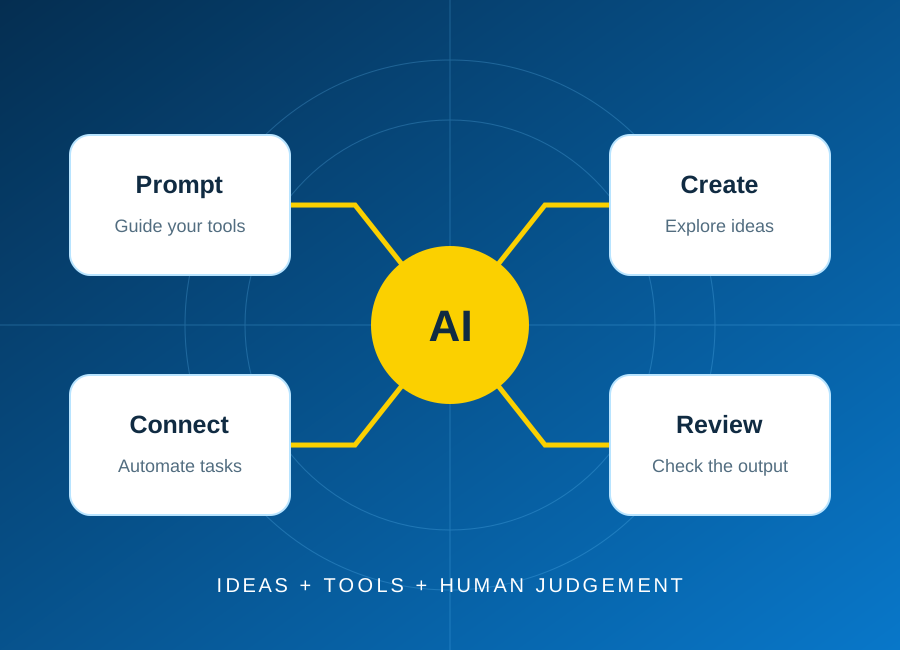
The starting pointA useful automation starts with a clear process, not a complicated tool.
Choose a small, well-defined task
Look for work that follows a predictable pattern: organising sample enquiries, drafting a meeting summary or turning a checklist into a structured report. Write down what arrives, what decisions are needed and what a good result should contain. Avoid starting with payments, medical decisions or other activities where a mistake could cause serious harm.
Separate the rule-based steps from the language-based steps. A date check or required-field check usually needs ordinary logic, not an AI model. AI may help draft or classify text, but a person should review uncertain or consequential results.
Design the inputs and review points
Use invented examples while learning. Define a simple output structure such as enquiry topic, missing details and suggested reply. Give the model context, constraints and examples of acceptable output. Tell it not to invent information that is missing from the input.
Place a review step before sending messages or updating records. Keep the original input alongside the draft so a reviewer can check accuracy. Do not upload personal, customer or confidential information to a tool unless you have permission and understand its data-handling settings.
Test failures as well as successes
Try short messages, spelling mistakes, incomplete requests and text that asks the system to ignore its instructions. Check whether the workflow keeps its expected structure and flags uncertainty. Record the cases that fail instead of judging the system from one impressive example.
Set limits on retries and tool permissions. If a service is unavailable, the workflow should show an error or request human help, not report a task as completed. Compare the time spent reviewing drafts with the time saved.
Build a demonstrable learning project
Create a small enquiry-drafting assistant using fictional messages. Present the process diagram, sample inputs, review screen and test checklist. Explain which steps are automated and which remain manual. This demonstrates more understanding than a screenshot of a single generated answer.
When exploring training, ask about prompt design, workflow logic, responsible data use and practical testing. Tool names can change; the ability to define and evaluate a process remains valuable.
Try it yourself
- Write five fictional enquiries with different missing details.
- Define a three-field output and one human approval step.
- Test all five cases and document at least one limitation.
References and corrections
For additional technical guidance, consult the source documentation:
These independent resources support further learning; they do not endorse ECAREERPLUZ, verify our course delivery or establish certificate recognition. Follow current manufacturer instructions and appropriate supervision for hands-on work.
Publisher: ECAREERPLUZ. Report an error or request clarification. Tool interfaces and requirements can change; confirm current details before acting.