
Observation before instruction: a Montessori starting point
Explore how a prepared environment, careful observation and thoughtful activity choices support child-centred learning.
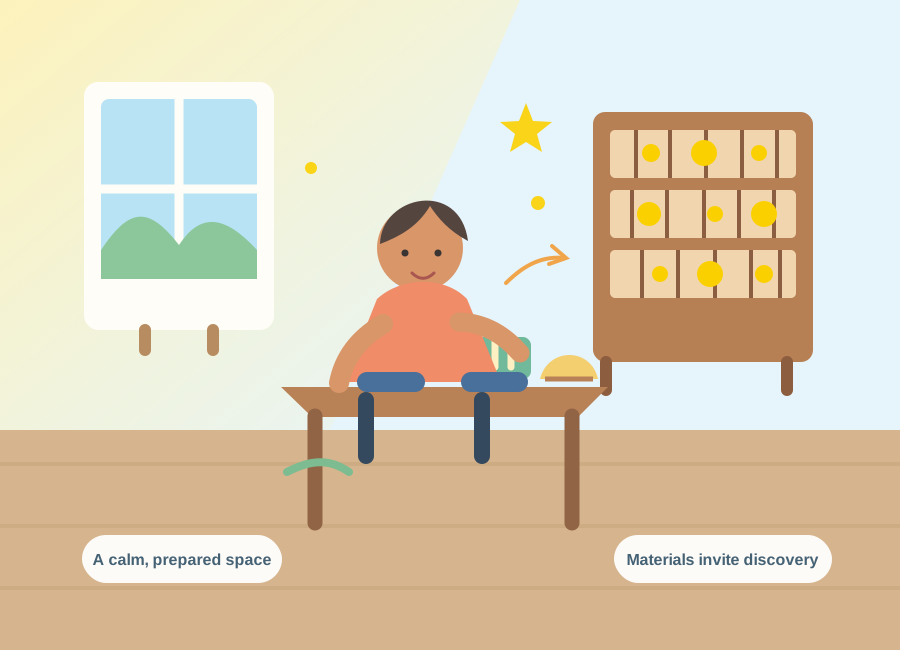
The starting pointObserve the child's engagement before deciding how much help to offer.
Understand the purpose of the environment
A Montessori-inspired environment aims to make purposeful activity accessible and orderly. Materials should suit the children's age, development and context. An attractive shelf alone does not make an activity appropriate or establish that a classroom follows a recognised Montessori programme.
Think about clear work areas, safe movement and how a child can find and return materials. Accessibility and safeguarding matter as much as presentation. Follow institutional procedures and the guidance of qualified educators.
Practise objective observation
Record what a child does rather than immediately labelling ability or behaviour. For example, an observation might note that a child repeated an activity three times and returned the material. It should not turn a short moment into a diagnosis or a fixed judgement.
Consider the setting, the child's comfort and the activity's demands. Share observations only through appropriate channels and protect personal information. A brief classroom observation cannot establish developmental outcomes.
Choose hands-on activities carefully
Practical-life activities can invite children to follow a sequence, coordinate movement and care for their environment. The educator's role includes demonstrating clearly, checking safety and deciding when support is appropriate.
Use age-appropriate materials and supervision. Small parts, liquids, tools and cleaning materials require particular care. Do not use a general online activity idea as a substitute for a local risk assessment or a child's individual support plan.
Connect theory with responsible teaching practice
When exploring educator training, ask about child development, observation records, lesson planning, safeguarding and supervised practice. Find out how the programme distinguishes Montessori principles from other early-childhood approaches.
Confirm the current certificate issuer, entry requirements and practice arrangements with the provider. A course title alone does not establish government recognition, professional registration or eligibility for every teaching role.
Try it yourself
- Sketch a safe, accessible activity area for a fictional classroom.
- Write an objective observation without labels or diagnoses.
- Prepare questions about safeguarding and supervised teaching practice.
References and corrections
For additional technical guidance, consult the source documentation:
These independent resources support further learning; they do not endorse ECAREERPLUZ, verify our course delivery or establish certificate recognition. Follow current manufacturer instructions and appropriate supervision for hands-on work.
Publisher: ECAREERPLUZ. Report an error or request clarification. Tool interfaces and requirements can change; confirm current details before acting.